KUALA LUMPUR, 9 August 2026 – Malaysia's Ministry of Finance published the GEAR-uP Report Card 2026 on 7 August 2026. GEAR-uP is the national programme that steers the country's six government-linked investment companies (GLICs) toward strategic domestic priorities. Valiance Health appears three times in the report, including a full feature story of its own.
The feature story: Building Standardised Health Data
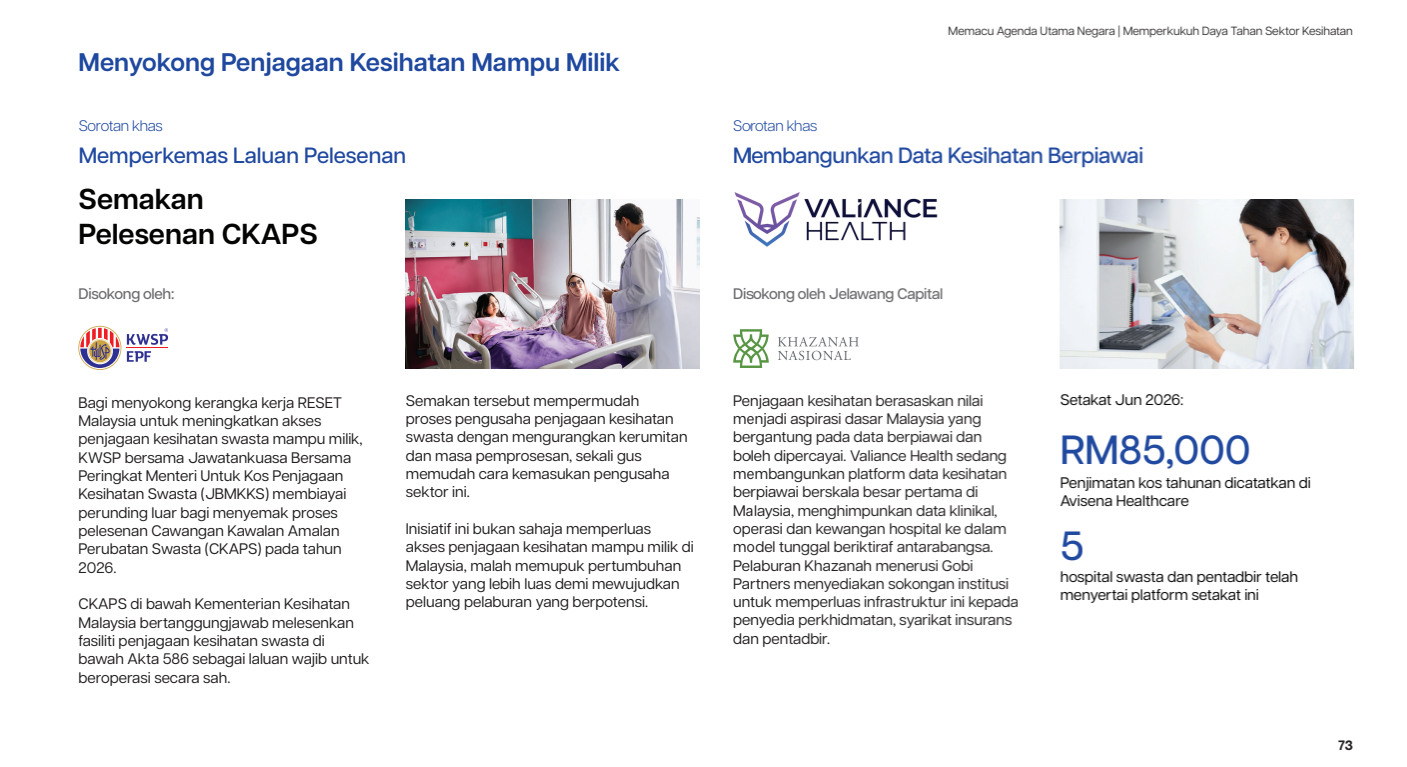
Page 73 sits in the healthcare chapter, Reinforce Healthcare Resilience, under the heading Support Affordable Healthcare Delivery. Next to a feature on the CKAPS licensing review, the report runs a second feature story: Building Standardised Health Data. It is about Valiance Health, and it is marked as backed by Jelawang Capital.
The report puts the argument plainly:
"Value-based healthcare has been a policy ambition in Malaysia for years, and its realisation depends above all on trustworthy, standardised data. Valiance Health is building Malaysia's first large-scale standardised healthcare data platform, aggregating clinical, operational and financial data from hospital systems and harmonising them into a single, internationally recognised model. Khazanah's investment via Gobi Partners provides the institutional backing to scale this infrastructure across providers, insurers and administrators."
— GEAR-uP Report Card 2026, page 73
Two numbers are recorded, as at June 2026:
- RM85,000 — annual cost savings demonstrated at Avisena Healthcare.
- 5 — private hospitals and administrators onboarded to date.
Named in the healthcare ecosystem
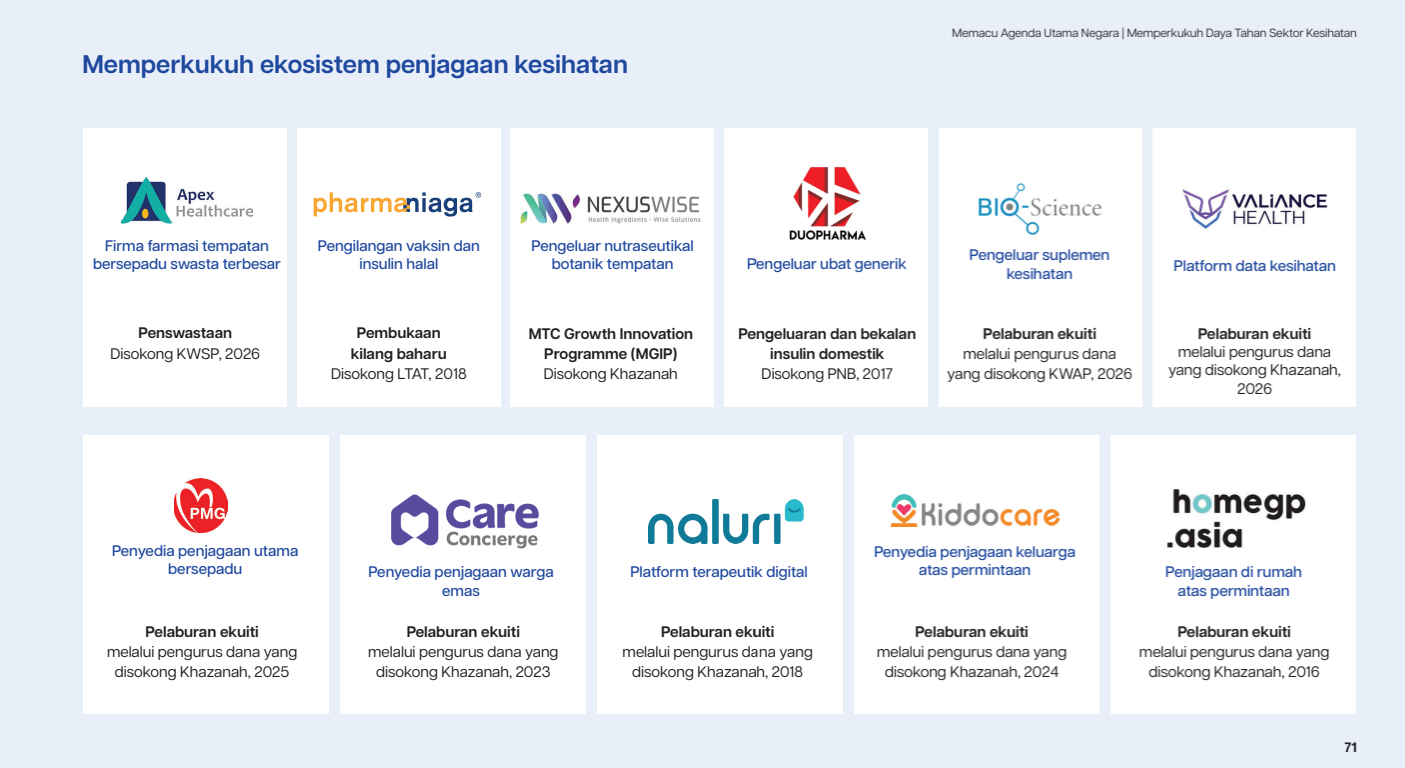
Page 71 maps the healthcare ecosystem that the GLICs now back. Valiance Health is listed as the healthcare data platform, an equity investment through a Khazanah-backed fund manager in 2026. It sits beside Apex Healthcare, Pharmaniaga, Nexuswise, Duopharma, Bio-Science, PMG, CareConcierge, Naluri, KiddoCare and homegp.asia.
Named in the startup pipeline
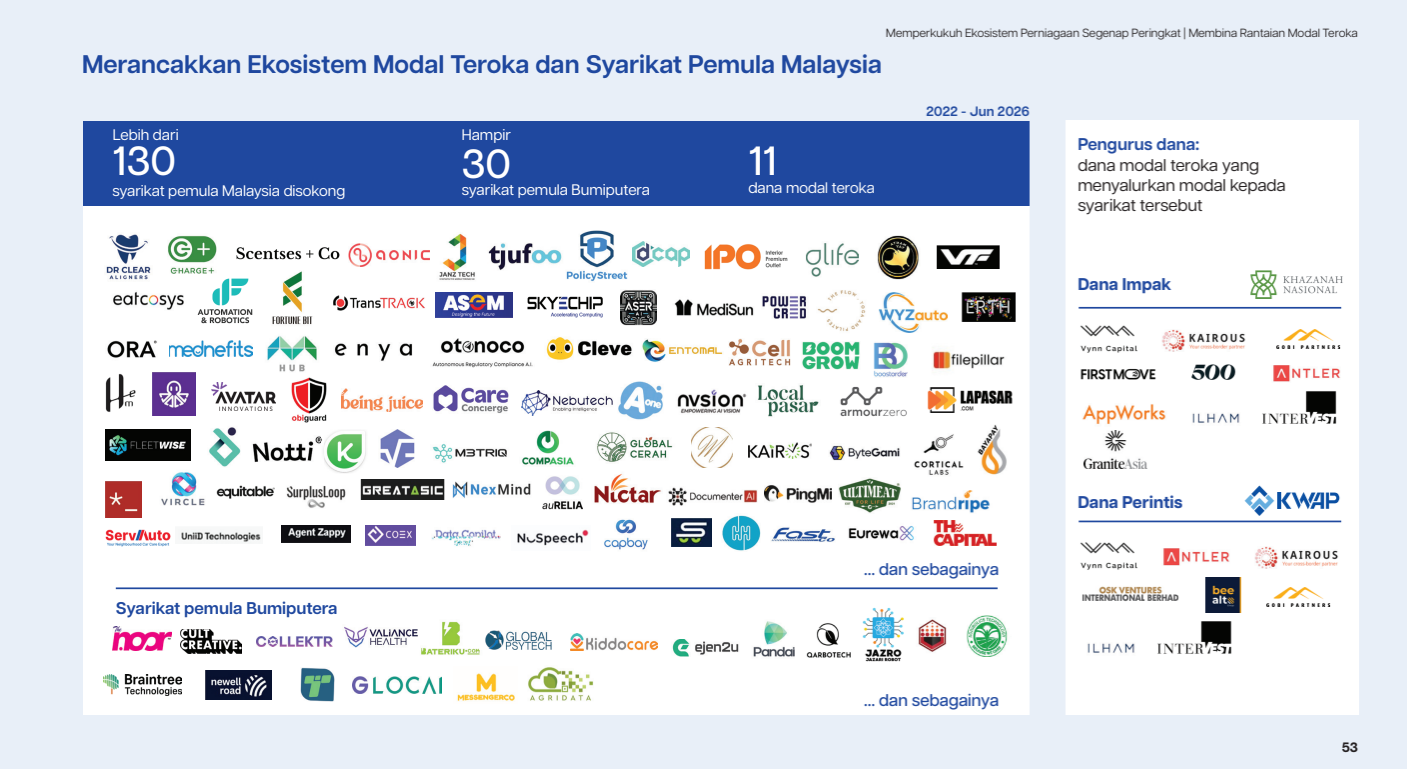
Page 53 covers the venture capital pipeline. Between 2022 and June 2026, the programme supported more than 130 Malaysian startups, close to 30 of them Bumiputera-owned, through 11 partner venture funds. Valiance Health is named among the Bumiputera-owned startups.
Why this matters
Malaysia's health system faces two pressures at once. The population is ageing, and chronic disease is rising. The report answers by building capacity. It backs local medicine manufacture, it speeds up licensing for new private providers, and it grows the care economy.
Capacity alone does not control cost. To judge whether a new facility or a new medicine is worth what it costs, someone has to compare it against what care costs today. That comparison breaks down when every hospital records the same procedure in a different way. Standardised data is what makes the comparison possible in the first place.
The report also gives the reason access matters so much. Only 22% of Malaysians hold medical insurance or takaful cover. Everyone else pays out of pocket or waits in the public system. Cost transparency is not an accounting detail for those patients. It is the difference between treatment and no treatment.
That is the problem Valiance Health was built to solve. Hospitals are not short of data. Fragmented systems, inconsistent coding and manual processes hold them back. A common data model turns that raw material into something a hospital can benchmark, an insurer can adjudicate against, and a regulator can read without a manual return.
Cost alone is not the whole picture. The supply chain and the business processes behind a bill have to be legible too. Patient access programmes for innovative medicines are the clearest example. These schemes change what a hospital actually pays for a drug, and they skew the price of the admission that contains it. A payor that cannot see that mechanism cannot set a reasonable reimbursement rate against it. That is a hard limit on any social health insurance design, and no amount of headline cost data removes it.
So the whole value chain has to be understood at once, because each party asks a different question of the same episode of care. The patient wants to see value for what they pay. The provider has to deliver that value and stay solvent. The payor demands evidence of cost-effectiveness before it reimburses. The supplier wants visibility into how its product is used and priced downstream. A single standardised model is the only place those four questions get answered from the same numbers.
The savings the report records show the shape of that return. They come from one hospital group, and they are the kind of leakage that manual review does not catch. Multiply that across a national benchmark, and the number stops being a rounding error.
What comes next
Five hospitals and administrators is a start, not a destination. Our focus for the rest of 2026 stays the same:
- Onboard more providers. Each new hospital makes the benchmark more useful for every hospital already on the platform.
- Deepen the clinical and cost detail. The finer the standard model gets, the more a hospital can act on it.
- Strengthen the standardisation pipelines. Better automated coding and mapping means less manual work at the hospital end.
Recognition in a national report is welcome. The measure that matters is a hospital that can finally see its own costs clearly, and act on them. That is what we build.
Read the report
- GEAR-uP Report Card 2026 landing page: mof.gov.my/gearup
- English edition: GEAR-uP Report Card 2026
- Bahasa Malaysia edition: Laporan Kemajuan GEAR-uP 2026
Valiance Health appears on pages 53, 71 and 73. All figures are as stated in the report, as at June 2026. Images are reproduced from the report, published by the Ministry of Finance Malaysia.